

My Car Failed Its MOT. Can I Still Drive It?
We get this question most days, usually from someone standing in reception holding a failure sheet, keys still in hand, asking "so... can I get home in it?" The honest answer depends entirely on two words on that sheet — and they're easy to miss if you've never seen one before.
Quick Answer
It depends on how your failure is graded. A Minor defect still means a pass — drive away, no issue. A Major defect is a fail, but you can usually still drive it if your old MOT certificate hasn't expired yet and the car is genuinely roadworthy. A Dangerous defect means don't drive it at all — not to the shops, not home, not "just this once" — regardless of how much time is left on your old certificate.
The Three Tiers — And What Each One Actually Means
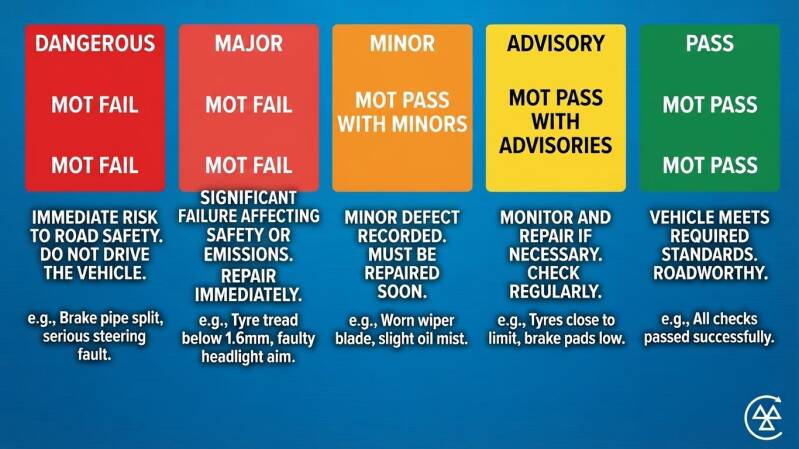
Since 2018, every MOT defect in England, Scotland and Wales gets graded into one of three bands. This is the bit that actually decides whether you're breaking the law by driving away.
Minor
A fault that's worth fixing but doesn't meaningfully affect safety or emissions right now — think a slightly cloudy headlight lens or light corrosion. The car still passes overall.
Major
A fault that could affect safety, other road users, or the environment. The car fails the test. If your existing MOT certificate is still valid and the car is genuinely roadworthy, you can usually keep driving it — but you're relying on your own judgement that it's actually safe.
Dangerous
A direct and immediate risk to road safety or the environment. This instantly invalidates any remaining days on your old MOT certificate, even if it had months left. The car should not be driven under any circumstances until it's fixed.
A Dangerous defect doesn't just fail the test — it overrides your existing MOT certificate entirely, on the spot. It doesn't matter if you had eight months left on it. From the moment that's recorded, the car is legally unroadworthy.
What Actually Happens If You Drive It Anyway
| Situation | What you're risking |
|---|---|
| Driving with a Dangerous defect | Up to £2,500 fine, 3 penalty points, and possibly a driving ban |
| Driving with no valid MOT at all | Up to £1,000 fine |
| Getting into an accident with a known Major or Dangerous fault | Insurers can refuse to pay out, arguing the car wasn't roadworthy |
| Stopped by police in an unroadworthy vehicle | The car can be seized, on top of any fine and points |
Worth saying plainly: a failed MOT doesn't automatically cancel your insurance, but if you're in an accident and the failure is relevant to what went wrong, insurers absolutely will use it against a claim.
The One Exception
Even with an expired MOT or a Dangerous fail, you're allowed to drive the car for one specific reason: getting it to a pre-booked repair appointment or MOT retest, and only if it doesn't make the fault worse or create extra risk on the way. That's it — not a quick detour via the shops, not the school run "since you're out anyway." Pre-booked, direct, and nothing else.
Why So Many Cars Fail in the First Place
If it's any comfort — roughly a third of cars fail their MOT the first time round. Tyres, lights and brakes make up the bulk of it, and most of it is genuinely preventable with a five-minute check before you book in: tread depth, working bulbs, and no warning lights sitting on the dash.
Failed an MOT and Not Sure Where You Stand?
Send us a photo of your failure sheet or bring it in — we'll tell you straight whether it's safe to drive and give you a fixed price to sort it.
Book Your RetestOr call/WhatsApp 01438 232556
MOT Failure FAQs
Yes — driving directly to a pre-booked repair or retest is allowed even with an expired MOT or a Major/Dangerous fail, as long as the vehicle isn't unsafe to be on the road at all and you go straight there.
There's no fixed grace period. If your old certificate is still valid and the fault is only Major (not Dangerous), you can legally drive until that certificate expires — but you shouldn't treat that as a countdown to ignore the problem.
Not automatically, but most policies assume your car is legal and roadworthy. If you're in an accident and the failed item played a part, insurers can use it as grounds to reduce or refuse a payout.
A Major defect could affect safety but doesn't present an immediate risk, so driving is usually still allowed under the conditions above. A Dangerous defect is judged to be an immediate risk right now, and it invalidates your MOT on the spot, no exceptions.
Add comment
Comments